

Carbon-Wood Composites
Built to Outlast Carbon
and Outperform Steel
Built in Philomath Oregon with expert craftsmanship using traditional
and advanced woodworking and manufacturing techniques.
The Most Comfortable High Performance Bike In The World
Don't let the natural appearance fool you into thinking it's just a furniture piece. Our composite of carbon, wood and Kevlar allows us to build a bike that is lively, durable, and more comfortable than bikes made of any other material.
Frames start at $4000 and complete bikes typically start at $7000Build times are currently around eight weeks
Our Bikes
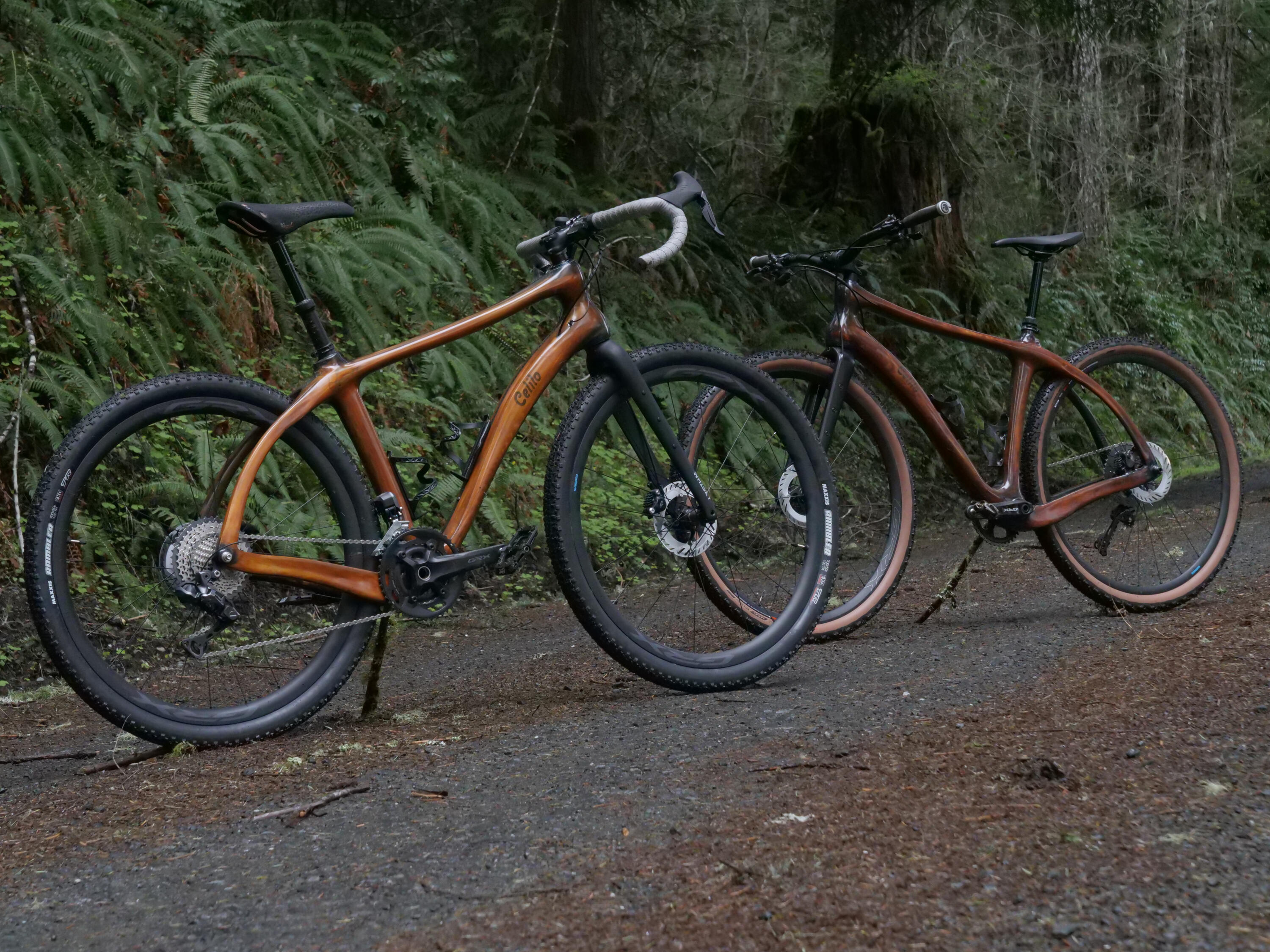
We build three types of frames: Hookset: our hardtails, Redd: our gravel bikes, and a drop-bar mountain bike we call the Anadromous.

Hookset: a trail hardtail
Hardtails are efficient. Ours are also comfortable. The wood actually absorbs the hits instead of just passing them through. We focus on composite strength, precise geometry, and the necessary durability to withstand years of hard riding. Engineers distinguish between Strength (how much load before it breaks) and Toughness (how much energy it absorbs before it breaks). Carbon is strong but brittle, like glass. Wood is tough, like leather. When you smack a carbon downtube on a rock, it shatters. When you smack a Celilo, it bruises. We prefer bruises to failures.

Redd: our gravel frame
Named after the gravel nests of the Pacific Salmon. This bike lives in the stones. It is designed to hold a line in loose chop and find traction where a stiffer bike would skate. Our gravel designs are engineered to make riding feel smooth across any terrain. We focus on fiber layup that mitigates fatigue, ensuring the frame handles long miles, potholed city streets, and technical sections with equal confidence.

Anadromous: goes anywhere
Like the fish it’s named for, this bike is built for migration. It is born in the shop but designed to swim upstream, transitioning from the salt of the city streets to the fresh grit of the fire roads. It doesn’t care about the substrate; it only cares about the journey. The Anadromous defies categories, engineered for riders who blur the line between aggressive hardtail and technical gravel. Boost spacing and an available custom fork deliver huge tire clearance, superior lateral stiffness, and confidence for the most demanding routes.
Testimonials
What People Say
"The bike really just disappeared today. I did not notice it. It just felt natural, like a well-worn pair of comfortable shoes."
- Sam M.
"The Celilo is a beautiful ride and I look forward to a long ownership and enjoying it on easy single track, rails-to-trails, and gravel roads. I’ll strongly recommend your bikes to others."
- Mark V.
"Wow! Wow! Wow! It is easily the most beautiful mountain bike I have ever seen. This frame is absolutely stunning!"
- Ozzie R.
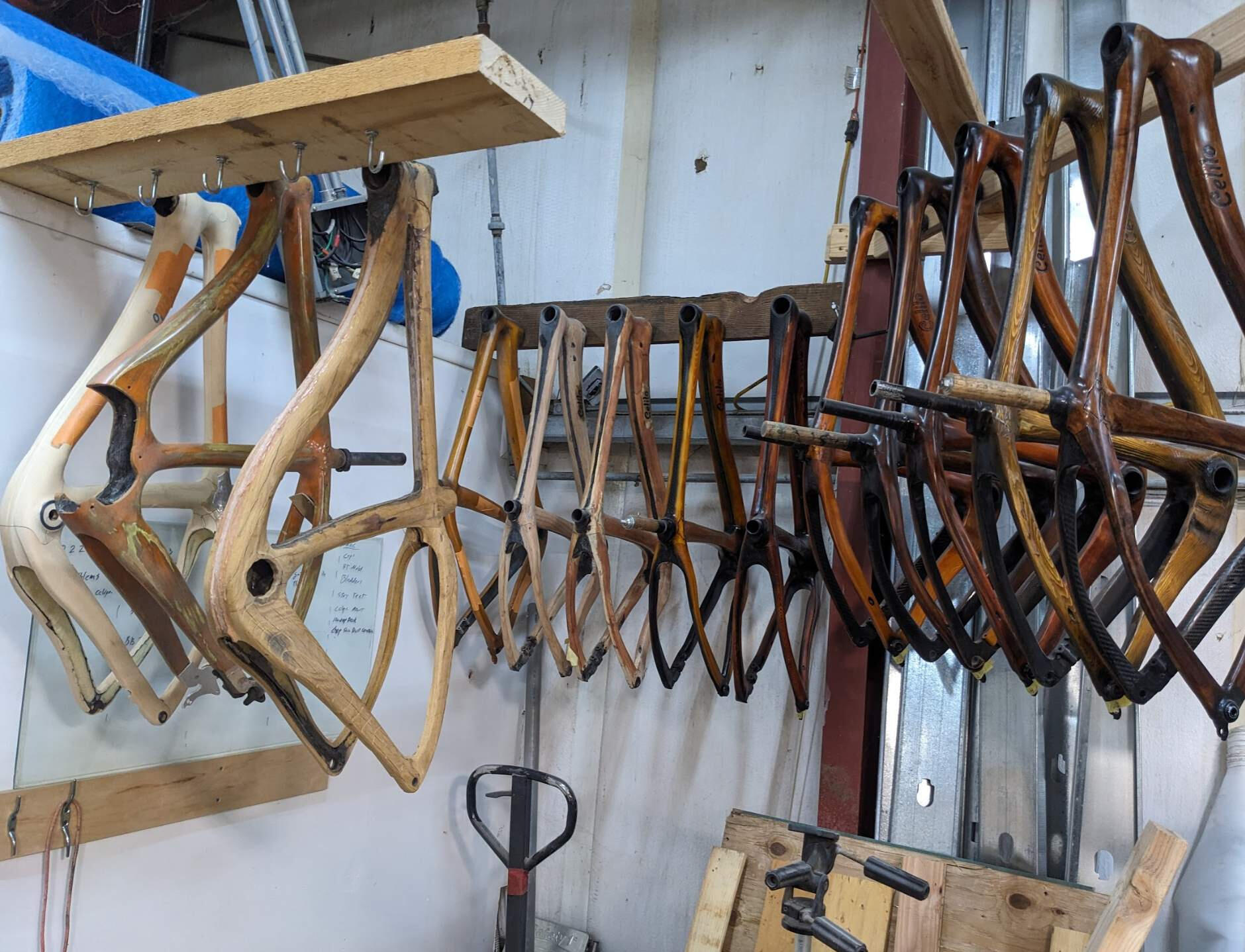
HOW IT'S MADE
Our Process
This is how our bikes are made. See how we use CNC manufacturing, composite techniques, and woodworking secrets to build the smoothest riding frames available.
WHY IT'S REAL
THE SCIENCE
Learn about what exactly it is that makes our bikes so comfortable while being able to perform at the highest level. Material science, testing, and breaking things to prove our claim that we build the most comfortable bike.
In the media
Stories About Our Bikes


Start Riding A Celilo
We build Mountain and Gravel performance frames, each defined by our unique design style and their incredible compliance. Start the journey toward your custom frame today, backed by our guarantee on the construction and craftsmanship behind our bikes.
Who Are We
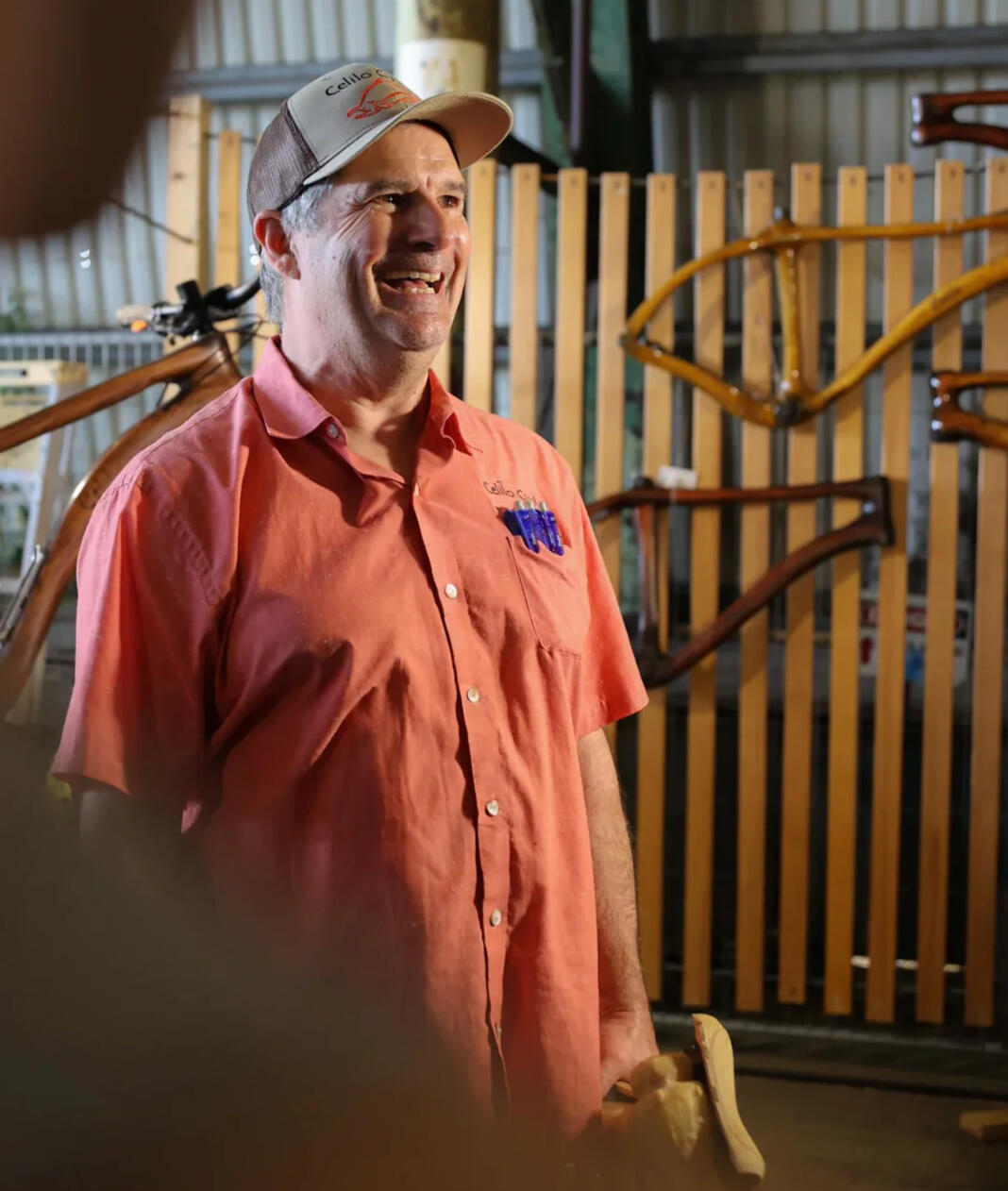
Celilo Cycles was started by Scott Campbell, a longtime Bend cabinet maker and homebuilder. Scott went back to school in the early 2010s and built his first wooden Celilo Cycle, “The Spruce Deuce,” as his masters of engineering capstone. Since then, Scott has been building wooden bikes in Philomath, Oregon near OSU, where he teaches mechanical engineering.
Since the first frame, the bikes have come a long way. What started as solid wood carvings have become completely hollow carbon fiber and Kevlar-reinforced frames. These bikes combine an artisan woodworker's skill and eye with modern manufacturing and material sciences. It survives the crash, absorbs the chatter, and looks better with a scratch.
Why Wood Rides Smoother
Carbon fiber is brilliant at being stiff and light. That's why it dominates high-performance cycling. But stiffness comes with a tradeoff: carbon transmits vibration efficiently. Every crack in the pavement, every root on the trail, travels straight through the frame and into your body. Over a long ride, that adds up.
Wood behaves entirely differently. It's viscoelastic, meaning it deforms slightly under load and absorbs energy in the process, rather than just passing it along. The cellular structure of wood naturally dissipates vibration as heat, a property that's been exploited for centuries in everything from violin bodies to tool handles. There's a reason nobody makes a carbon fiber axe handle.
What About Titanium?
Titanium has a reputation for the "best ride feel" in cycling, and it's not unearned, but it's also a bit misunderstood. Titanium's comfort doesn't come from damping. It comes from flex. Titanium has a lower modulus of elasticity than steel, so builders can design frames with thin-walled tubes that bend slightly under load and spring back. That flex takes the edge off impacts. But the vibration itself still travels through the material, it's just that the frame gives a little instead of transmitting it all directly.
The problem is that flex and damping aren't the same thing. A titanium frame deflects, then returns that energy. A wood frame actually dissipates it. Think of it this way: titanium is a trampoline, wood is a mattress. One bounces back, the other absorbs.
Our frames use both approaches. The composite core provides stiffness and strength comparable to carbon, while the wood shell genuinely dampens vibration rather than just flexing around it. The result is a ride that's smooth without feeling dead-responsive when you put the power down, forgiving when the road or trail gets rough.
Tougher Than It Looks
That's a Celilo frame tube getting slammed into a steel lumber rack.
No special treatment, no camera tricks-just the same construction that goes into every frame we build. It doesn't break.
This surprises people. Wood seems like it should be fragile, and carbon fiber has a well-earned reputation for catastrophic failure when it takes an impact wrong. So what's going on here?
The answer is in how the materials work together. Carbon fiber is incredibly strong in the directions it's designed for-pulling, pushing, resisting flex. But hit it from an unexpected angle, and it doesn't bend. It cracks. It shatters. Once a carbon frame starts to fail, it fails all at once.
Wood fails differently. Its fibrous structure absorbs impact by crushing and deforming locally rather than propagating a crack through the whole part. And Kevlar - the same material used in body armor - is specifically engineered to resist puncture and distribute impact forces. It's what keeps the whole thing from getting to the point of failure in the first place.
When you combine a wood outer layer with carbon fiber for stiffness and Kevlar for impact resistance, you get a frame that's not just strong but tough. Those are different things. Strength is how much load a material can take. Toughness is how much abuse it can survive - how much energy it can absorb before something actually goes wrong.
Carbon bikes are strong. Our bikes are tough.
That matters when you case a jump, clip a tree, or drop your bike in a parking lot. It matters over years of riding, when small impacts accumulate. And it matters for peace of mind, knowing your frame can take a hit and keep going.
Precision Engineered. Hand Finished.
The value of every Celilo frame is earned through meticulous design and hands-on expertise. If you're seeking superior comfort and a bike that outlasts carbon, you found it here.
Welcome to Our Philomath Workshop
This is the heart of Celilo Cycles. We don't have a showroom or a factory, we have a shop, and it’s where the actual work happens. Here you'll find a record of our process, our challenges, and the story of our bikes, including the people who ride them.
It took us five years from the first frame to get to something we were proud enough of to put our name on and sell to someone we weren't related to. That patience shows not just in the finished product, but in the manufacturing process we've developed to build these bikes. This page is our open door to that process, a record of our progress, our challenges, and the spaces where it all happens.
Materials
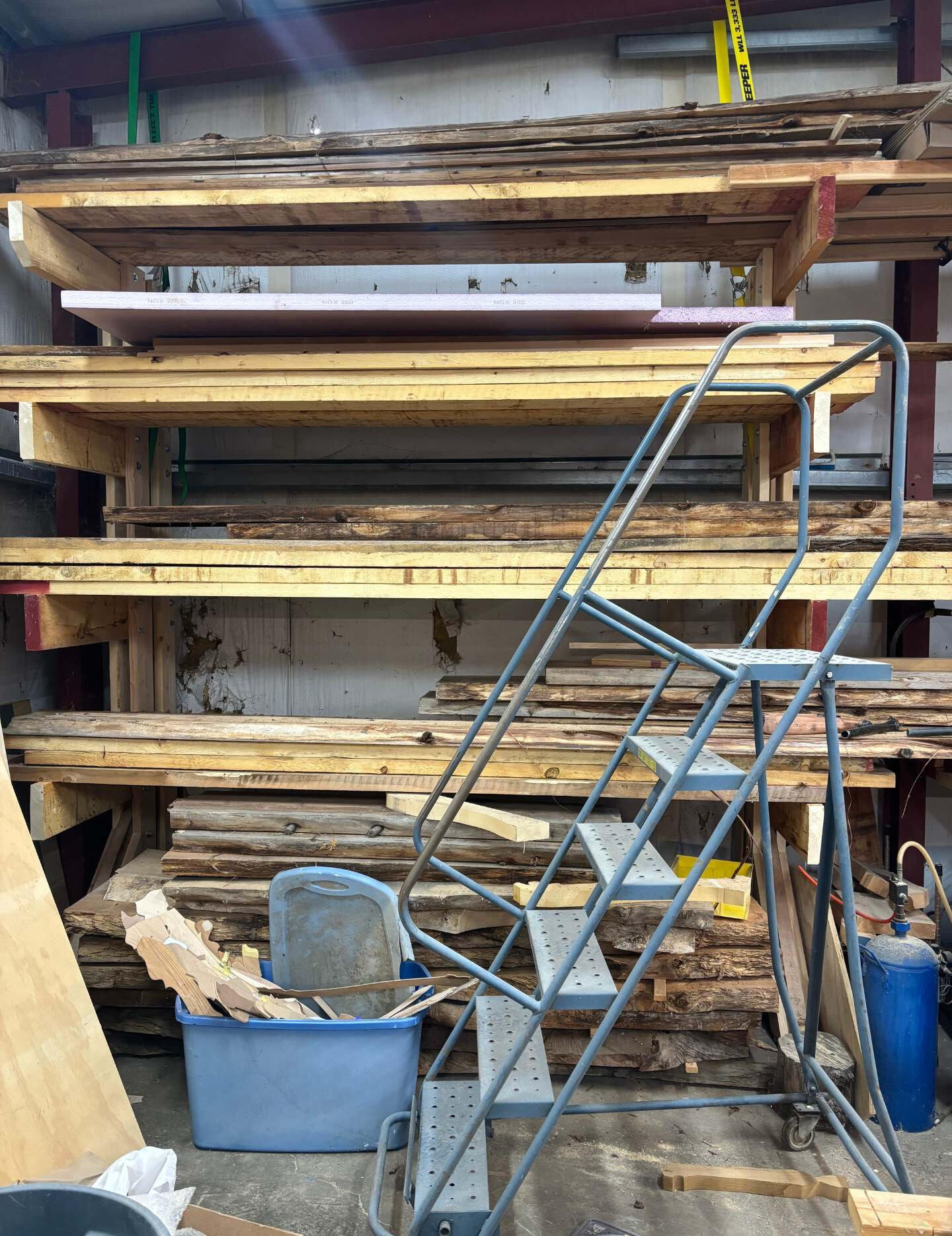
You may have seen wooden bikes before: bamboo lashed at the joints, laminated strips glued together. Our process is different. If you're here, you've almost certainly seen carbon fiber frames, but might not know exactly what goes into them. We use wood that is domestically sourced-usually from our backyard in the Pacific Northwest-along with carbon fiber and Kevlar as the primary materials in our bikes.
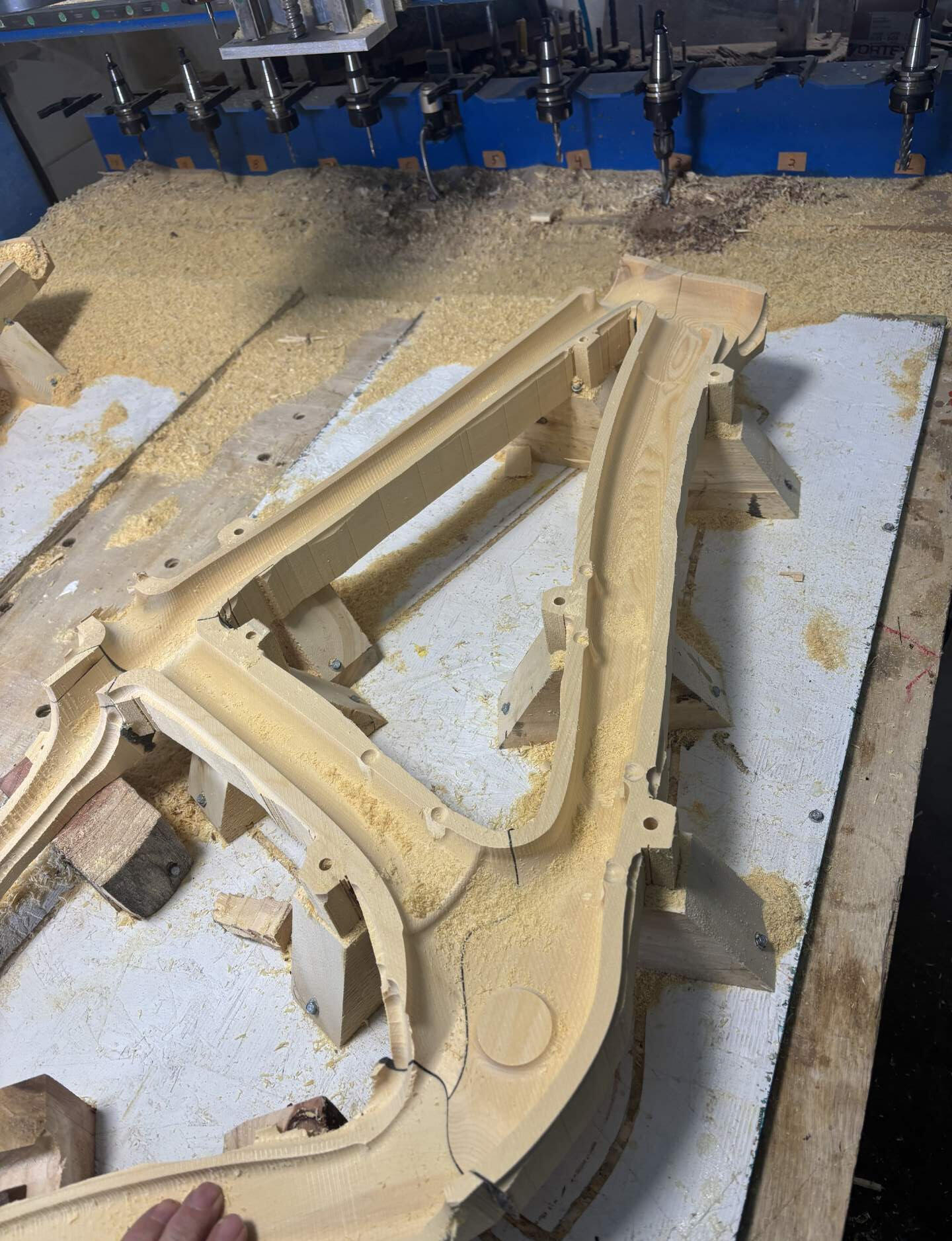
Our build process is more similar to that of a custom carbon frame than that of the "typical" wooden bike. Rather than laminating strips of milled wood together, which is the more common practice in the somewhat uncommon field of wooden bike building, we essentially machine a mold out of solid wood. We started out using bicycle inner tubes to pressurize the carbon inside the wood. It worked, but 'working' isn't enough when you're hurtling down a fire road at 40mph. So we engineered custom latex bladders that inflate inside the hollow frame, smashing the carbon and Kevlar against the wood grain with aerospace-grade force. No voids. No delamination. Just a solid, unified composite. The whole bike becomes a true composite-not just a mix of different materials bolted or bonded at the seams.
Machine Room
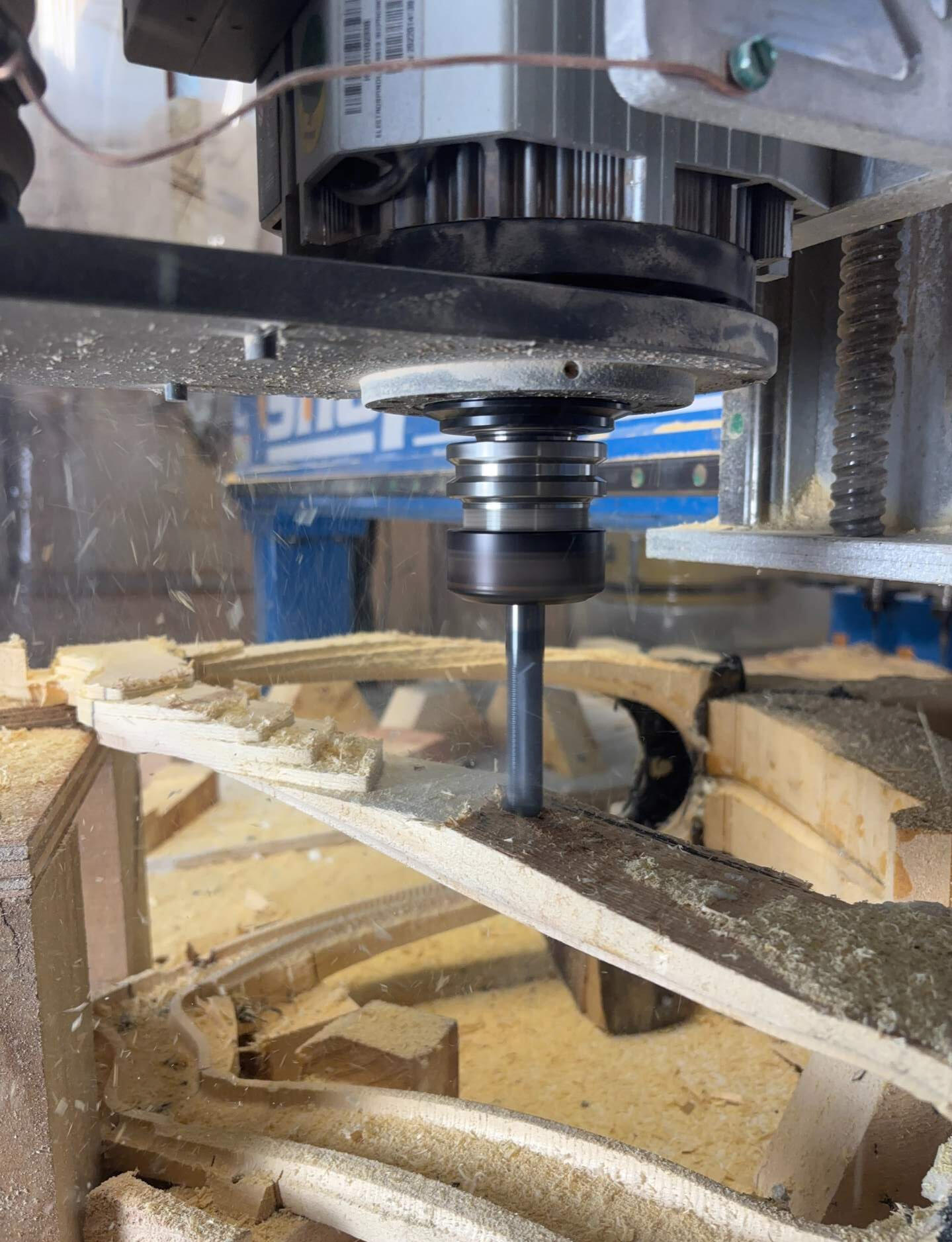
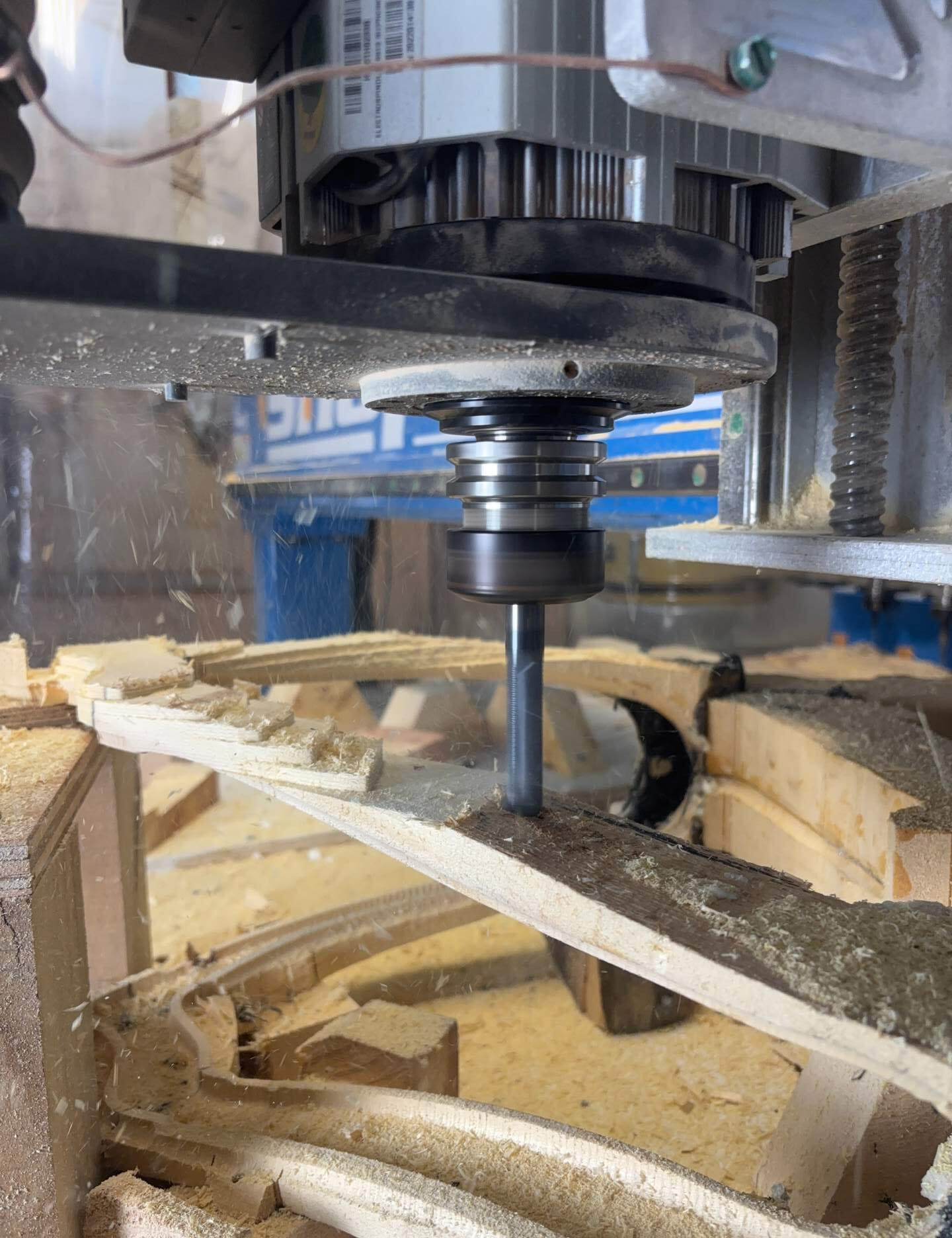
This room is the bridge between digital engineering and the physical bike-where CAD designs become tangible forms. We currently run two CNC routers: a trusty 4x4 Shopsabre that's been with us since the garage days, and a larger, more robust machine we added when we moved into our Philomath facility.
At least 26 separate machining operations take place during the build of each frame, adding up to over 14 hours of machine time. That's exactly what's needed to produce the organic curves, perfect joints, and exact alignment each frame requires. The extra machine capacity lets us fit both halves of a frame onto the bed of one machine, leaving the other flexible for making custom tooling and other projects. The large bed of a 5x5 CNC helps reduce fixture changes and helps us hold even tighter tolerances in the complex, hollow structures that form the core of our frames.
The Composite Lab
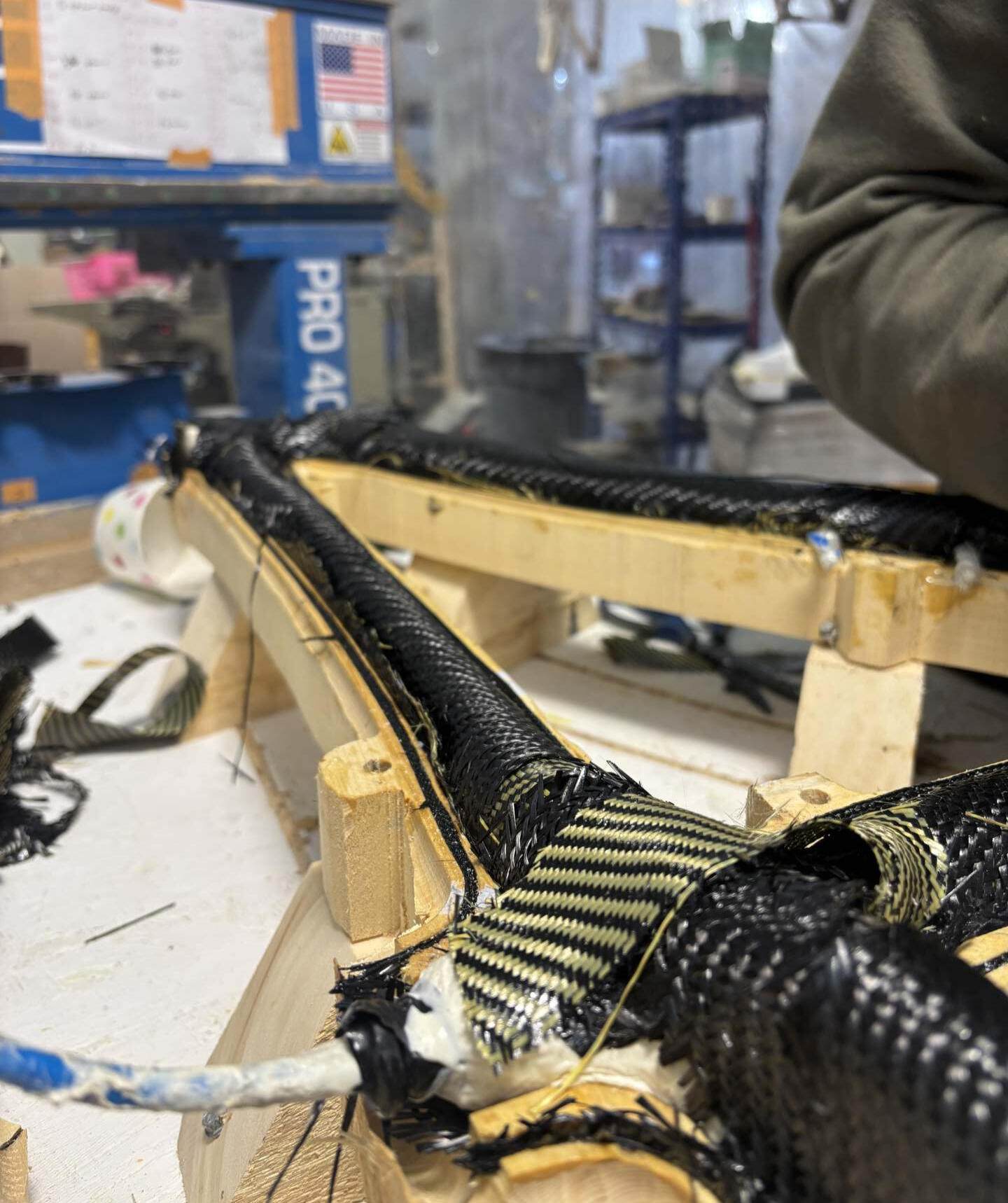
This is where wood meets carbon and Kevlar. Our machined wooden shells are reinforced with a strategic layup of carbon fiber and Kevlar, techniques borrowed from aerospace and other bike builders, but applied in a way that's unique to our frames. We custom make latex bladders for all of our frames for the best layup.
The space houses all of our composite fibers and resins, a two-frame-capacity curing oven, and an eclectic collection of measuring, cutting, and spreading tools. We apply engineering principles and calculations to ensure the composite reinforcement provides the stiffness and light weight of a race bike, while the Kevlar adds a layer of toughness that allows our frames to withstand abuse that would compromise carbon alone.
For critical interfaces like the bottom bracket and headset, we figure them into the fiber layup so that these areas are structurally integral to the frame-not merely bonded or glued in after the fact. The dropout is the only interface that isn’t completely integral to the frame, one half of it pivots to provide single speed and belt drive tensioning capabilities.
The Finishing Room
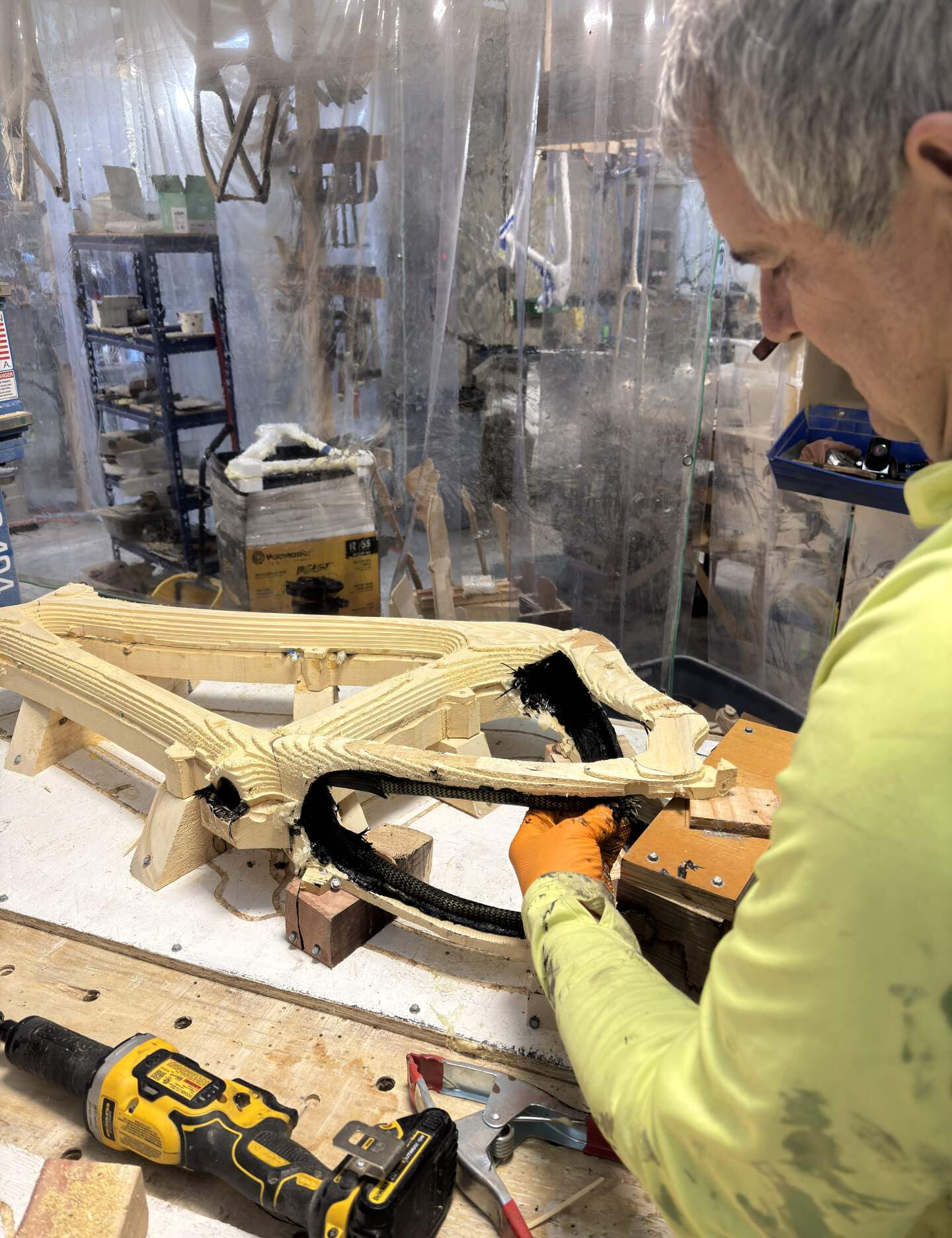
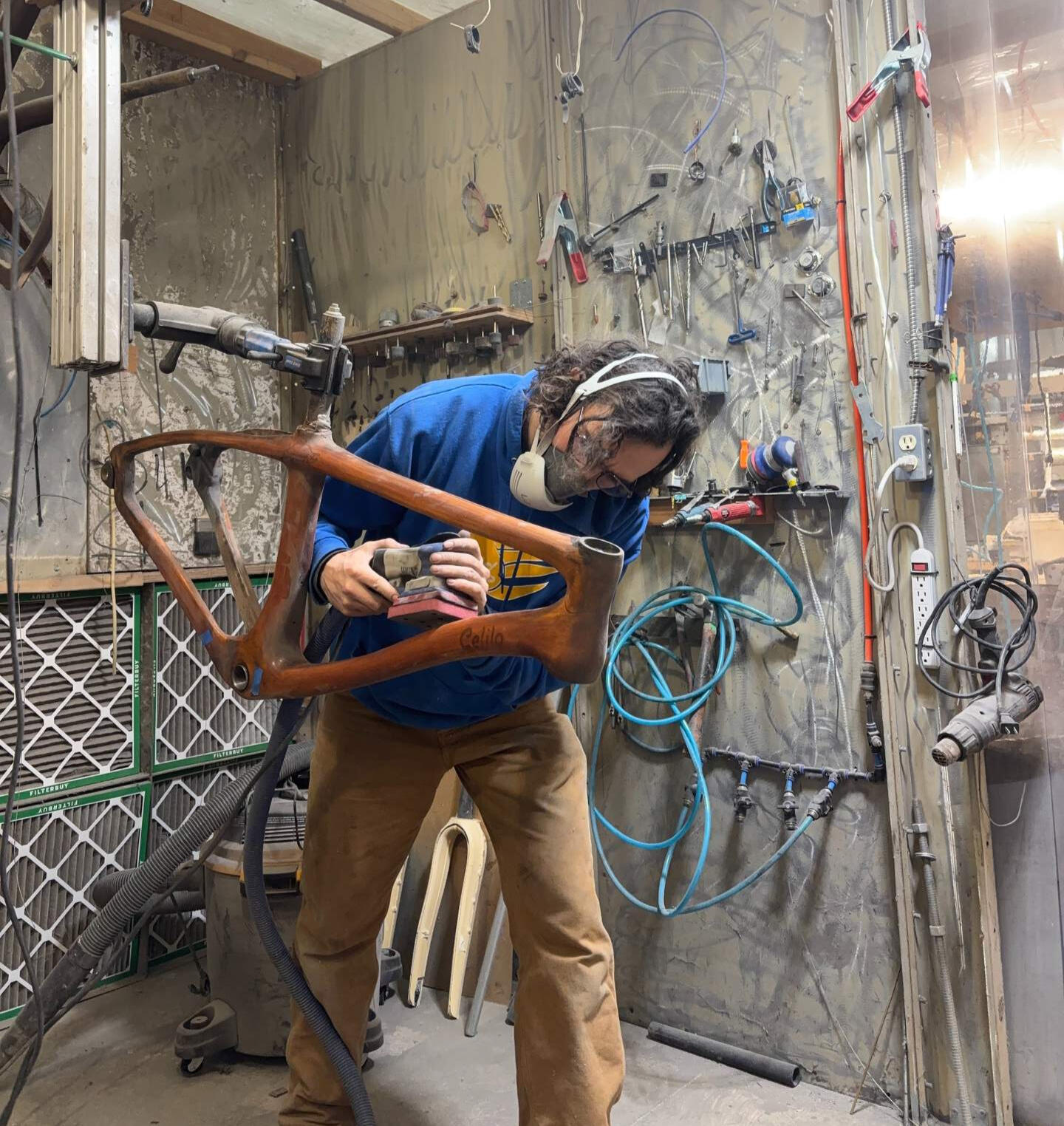
This is where the frame finds its final form. No matter how efficient our machinery becomes, up to twenty hours of dedicated human work goes into constructing and finishing each frame. The largest commitment of time is sanding-a slog of a process that demands the patience and distinct touch of a master woodworker.
We use over a dozen different sanding implements on a single frame, switching between tools to soften machining marks on the complex curves and corners of the geometry. Sanding is the price we pay for working with wood. There is no shortcut. For twenty hours, we work through the grits, erasing the tool marks left by the robot, smoothing the transitions until the frame feels like a single, grown object. It is tedious, dusty, and absolutely necessary.
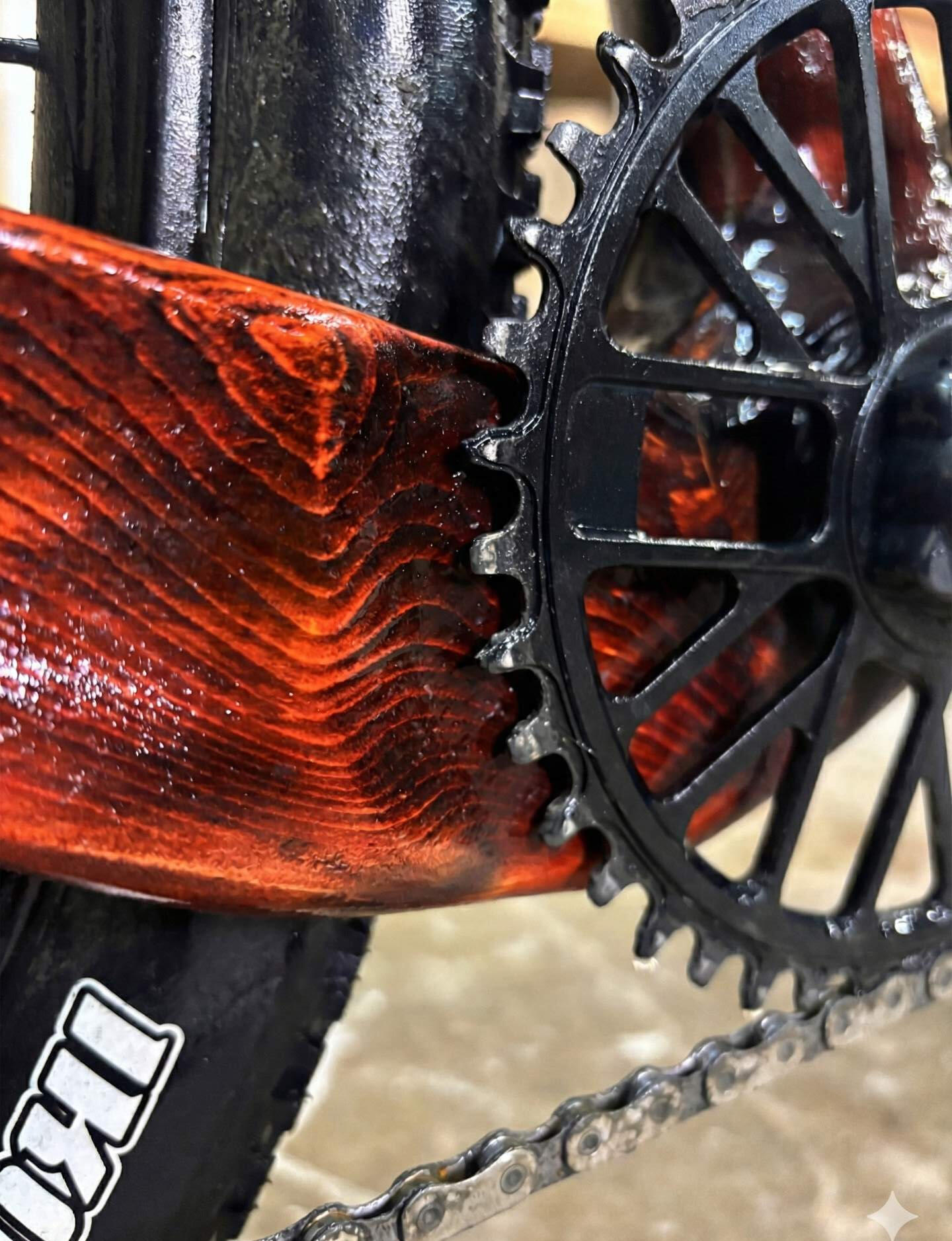
This is followed by blends of stains, inks, and oils to color the wood grain, sealed beneath a durable two-part automotive clear coat and finished with a ceramic wipe for lasting protection. We've stored bikes outside for years in Oregon without issue.
Alignment & Interfaces
We employ a variety of shop-made alignment tools to ensure every mating surface is perfectly planar, guaranteeing tight interfaces between our frames and components. Instead of choosing the simplest options, we select component standards that are the most effective for our design.
Where off-the-shelf parts fell short, we engineered and manufactured our own solutions: solid carbon fiber dropouts that pivot for adjustability, featuring flat-mount brake surfaces and a ridged index system that actively prevents the creeping alignment issues common with other sliding designs.
Precision Engineered. Hand Finished.
The value of every Celilo frame is earned through painstaking design and hands-on expertise. This is what we make. If it sounds like what you're looking for, let's talk.
A Durable Trail Bike
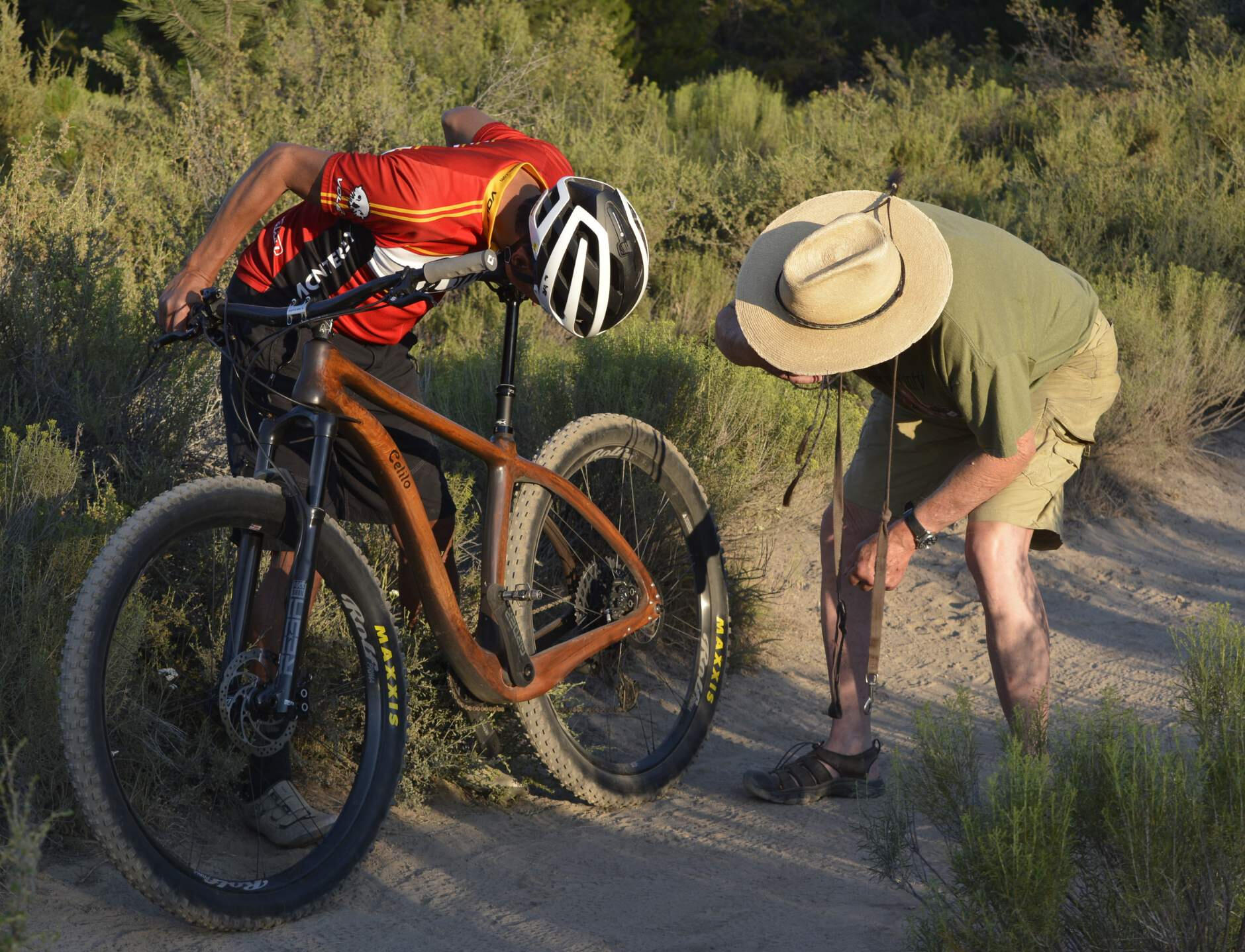
In a world of complex suspension designs and radical geometry we focus on the fundamental efficiency and direct trail feedback of the hardtail. Our frames are built to be responsive, predictable, and structurally bombproof. We use proven geometry that won't be out of style next season.
The Celilo is a true trail hardtail.
With two and a half inch knobby tires and a 120mm suspension fork the vibration damping of the wood is more subtle, but always present. On the trail, the wood earns its keep - reflecting rocks, absorbing impacts that would crack carbon. What you get instead are character-building scratches that prove you really ride it.
Trail Feel
The direct feedback of a hardtail keeps you connected to the trail. Our wood composite filters the punishment without numbing the information - you feel what matters, not what hurts.
Toughness
Rocks, roots, cased jumps, parking lot falls. Where carbon cracks catastrophically, wood dents and keeps riding. This frame is built for years of real use.
Efficiency
Boost spacing and dropped stays create a rear triangle that puts power into the wheel, not into frame flex. Responsive out of the saddle, efficient in it.
Build Specifications
Build it out how you want to: boost spacing and drop stays give it a powerful base, completely clean with all internal routing, clearance for 2.6" tires, and pivoting, all carbon UDH dropouts that are made in house.
Geo Charts
Three sizes available. Click to enlarge.
Small Hardtail

Medium Hardtail

Large Hardtail

Own a Hookset Hardtail.
Ready to build your Hookset? Put down a deposit and we'll schedule a call to configure your frame. Wait times for frames are usually between 4-10 weeks, with frames starting at $4000 and complete bikes starting at $7000. Custom geometry is available at an added cost.
The Anadromous Bike
An Anadromous fish, like a Salmon or a Steelhead migrates between fresh and saltwater, having to survive and travel great distances in two completely different environments. Similarly, our Anadromous bike has evolved to live some of its life on gravel roads, and some of it on rooty, rocky trails. Like its namesake fish it doesn't just survive, it's an expert in both domains.
This Bike Evolved For This
We crossed our gravel and mountain bikes in search of the riding traits we wanted to find. Standard gravel geometry couldn't accommodate the tire size and clearance that we wanted, so we borrowed the boost spacing with drop stays from our hardtail frame and designed our own fork. We wanted something faster riding than our hardtail, and that could really make the most of the vibration damping qualities of a wood composite frame. Is it a fully rigid mountain bike with drop bars? Or a boost spacing gravel bike? To us that doesn't really matter, it can stand alone as its own bike. An Anadromous ride that can take you from town to the mountains, and back, the fun way.
Clearance
The frame clears 2.35" tires on 29" wheels with room for mud. That's not a gravel bike pushed to its limits — we started with boost spacing and drop stays borrowed from our hardtail, then designed the geometry around the tire size we actually wanted. Drop bars on a bike that doesn't pretend it's not going on trails.
The Fork
We make our own fork. It's wood composite, same construction as the frame, and it's the highest-clearance gravel fork we know of. Most fork options for bikes like this are either carbon (stiff, harsh) or suspension (heavier, more maintenance). Ours rides smooth without adding complexity. It's the front half of why this bike feels the way it does.
Full Composite
A lot of gravel bikes try to solve comfort with flexible seatposts or compliant handlebars: aftermarket fixes for frames that transmit too much vibration. The Anadromous is wood composite from dropout to dropout. The damping isn't bolted on. It's the whole bike.
Build Specifications
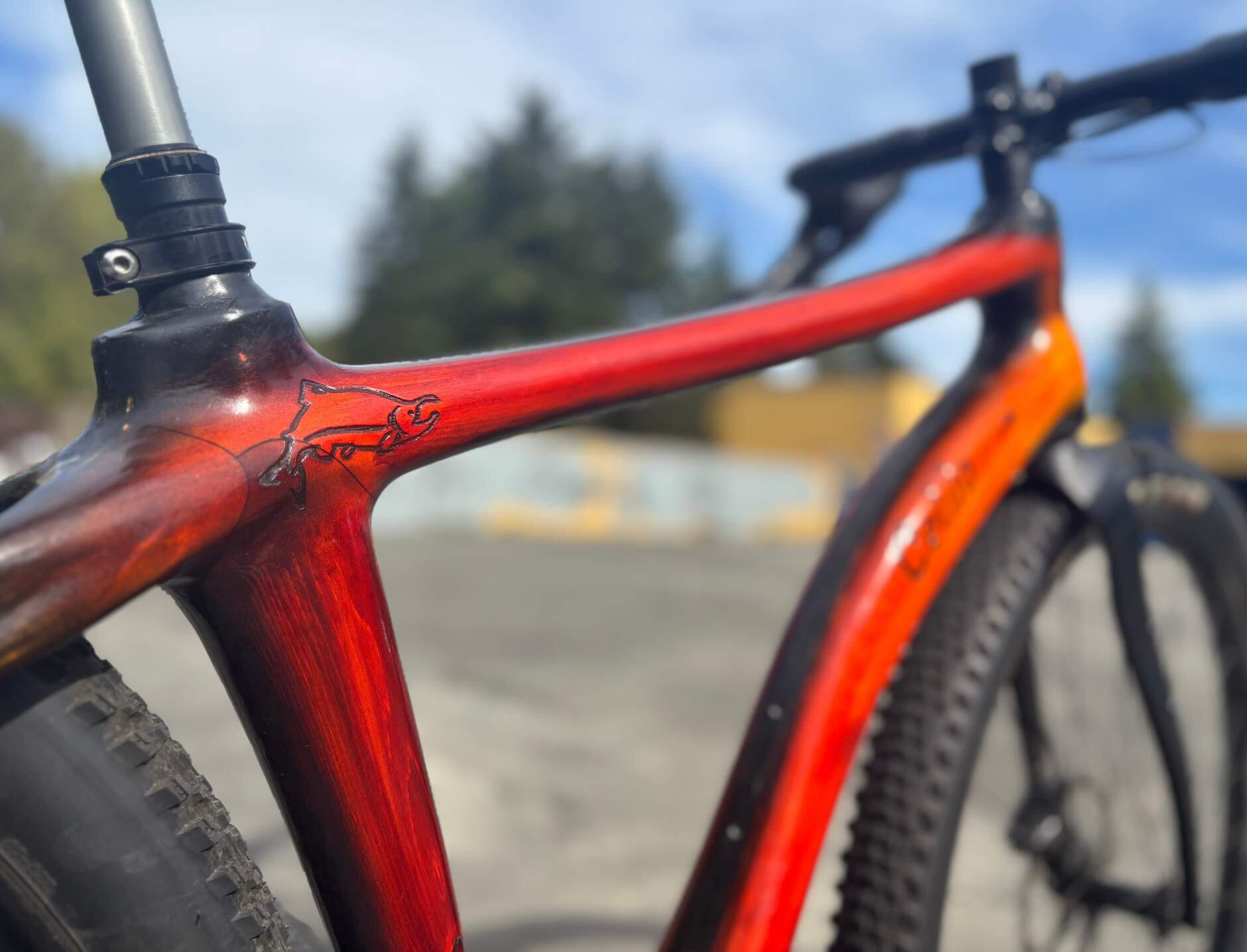
The Anadromous is built around boost spacing and 29" wheels, with geometry that accommodates a 300mm dropper post and fully internal routing throughout. Our house-made carbon UDH dropouts ensure compatibility with the widest range of drivetrains for ambitious builds, including wireless electronic setups with Eagle AXS or Shimano Di2 mullet configurations for maximum range.
Get a beautiful bike that can take you anywhere.
Start your Anadromous build with a deposit, and we'll reach out to plan your configuration. Wait times for frames are usually between 4-10 weeks, with frames starting at $4000 and complete bikes starting at $7000. Custom geometry is available at an added cost.
Redd: Gravel Bikes
Our gravel frame highlights wood's superb damping properties and puts it in a package that can find itself at home on logging roads, chipseal, singletrack or commuting between skyscrapers.
Composite Mastery
Take this bike out all day, heck, live in the saddle for a week. Unlike mass produced carbon frames, we can fine tune our composite schedule to suit the intended purpose and type of rider. Our gravel bike is the most compliant, smoothest riding frame available because of the unique wood-composite construction and the engineering that bring out the best of both. That's a claim backed up by our testing, and by every Celilo owner. Like a wooden baseball bat this frame eliminates vibration and chatter before it reaches the rider making even longer days within reach.
All-Day Comfort
Wood's natural damping shines brightest over long miles. Chatter from chip seal, buzz from hardpack, vibration from washboard - it gets absorbed instead of transmitted. You finish fresher.
Versatility
50c tire clearance, dropper compatibility, internal routing. This frame handles everything from gravel races to bikepacking to potholed city commutes without compromise.
Precision
Every frame is hand-finished to exact tolerances. House-made carbon UDH dropouts, flat mount brakes, and the option for 2x if you want it. Nothing generic, nothing off-the-shelf where it matters.
Frame Specifications
As with all of our bikes, our gravel frame features full internal routing, house made carbon fiber UDH dropouts for flat mount brakes, clearance for 50c tires, and dropper compatibility for even more versatility. All of our bikes are compatible with 2x drivetrains, but we don't install the hanger unless it's specifically requested to keep things clean.
Geo Charts
Three sizes available. Click to enlarge.
Gravel Small

Gravel Medium

Gravel Large

Order Your Frame
Reserve your Redd with a deposit. We'll set up a call to dial in the details. Wait times for frames are usually between 4-10 weeks, with frames starting at $4000 and complete bikes starting at $7000. Custom geometry is available at an added cost.
Contact Us
Have Any Questions About Our Bikes, or Want to Demo a Bike in Philomath, OR?
Reach out with this form. If you want to talk bikes, we'd love to get on the phone.
These are a couple of typical builds for our Redd and Anadromous framesets. Complete custom components are also available.
Shimano GRX/XTR Di2- $9,500
Shimano's GRX Di2 825 with XTR 12-speed drivetrain- wireless electronic shifting with the smoothest, lightest rear derailleur Shimano makes. Full Thomson cockpit on a Cane Creek headset, Astral Serpentine carbon wheels laced to White Industries CLD+ hubs, and a White Industries crankset and chainring.
SRAM RED/X0 AXS - $10,000
SRAM's RED eTap AXS drop bar shifters with the X0 Eagle T-Type 12-speed drivetrain — wireless electronic shifting with one of SRAM's best mountain derailleurs. Full Thomson cockpit on a Cane Creek headset, Astral Serpentine carbon wheels laced to White Industries CLD+ hubs, and a White Industries crankset and chainring. High-end performance for riders in the SRAM ecosystem.
SRAM Rival/GX AXS - $7,500
SRAM's Rival eTap AXS drop bar shifters with the GX Eagle AXS 12-speed drivetrain wireless electronic shifting with SRAM's proven trail derailleur. Full Thomson cockpit on a Cane Creek headset, Astral Serpentine alloy wheels laced to White Industries CLD+ hubs, and a White Industries crankset and chainring. Wireless performance for riders in the SRAM ecosystem.

Carrd Designer & Website Inspiration: Carrd Templates